



Maersk posted an operating profit of USD 3.3 billion in the third quarter of 2026, up 155 % year on year. Higher container shipping rates helped improve its results, even though volumes fell slightly. However, the gradual return of vessels to the Suez Canal could squeeze the high margins. Shorter routes save fuel and time, but they also free up vessel capacity and create room for freight rates to fall. [2]
About the company
A.P. Møller – Mærsk is a Danish transport and logistics group headquartered in Copenhagen, whose shares are traded on Nasdaq Copenhagen. It provides ocean container shipping, logistics services and port terminal operations, linking the transport of goods by sea with warehousing and delivery to the customer. Each of these activities has different margins and a different sensitivity to changes in freight rates, which affects the stability of the group’s overall performance.1
New outlook comes closer to analysts’ expectations
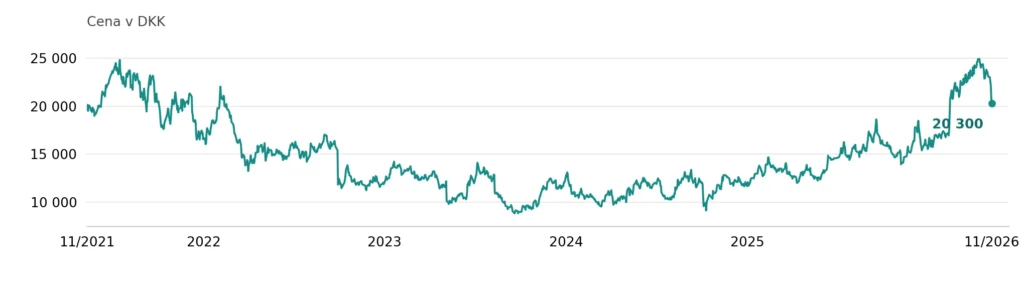
Maersk’s revenue rose 27 % year on year to USD 18.1 billion. Earnings before interest, taxes, depreciation and amortization (EBITDA) rose 75 % to USD 4.71 billion, but fell about 6.5 % short of the average analyst estimate in an LSEG poll. The company also raised its full-year underlying EBITDA guidance from USD 10.5–12.5 billion to USD 14–14.5 billion. Analysts had already been expecting USD 14.02 billion. [3] The new outlook therefore largely confirmed their expectations, even though it represented a significant improvement on management’s previous estimate. On 5 November, the day the results were published, Class B shares closed at DKK 20,870, a daily decline of 5.99 %.*2
Higher rates outweighed rising costs
The biggest improvement came from ocean shipping. The average freight rate achieved rose 46 % to USD 3,287 per forty-foot equivalent unit (FEU), while the volume transported fell 0.8 %. Unit costs at a constant fuel price increased by 4.8 %. The Ocean division’s operating margin rose from 6.2 % to 20.6 %, mainly thanks to higher rates. Operating profit was also boosted by the extension of the estimated useful life of vessels from 20 to 25 years, which reduced quarterly depreciation by USD 176 million. This accounting change did not in itself increase cash generation. The results therefore do not yet prove that Maersk can achieve similar margins when shipping is cheaper. To sustain them, it would need to reduce its cost per container accordingly. [4]4
Suez could lower both operating costs and freight rates [5]
The gradual restoration of shorter routes could increase pressure on rates. On 2 November, Maersk and Hapag-Lloyd announced the return of their joint ME1 service between India and Europe to the Suez Canal, instead of sailing around Africa. The same volume of goods can thus be transported in less time and with less vessel capacity. The vessels freed up could increase shipping supply and intensify price competition. Fuel cost savings could then be outweighed by the drop in revenue caused by lower rates. Further route changes, however, remain contingent on the security situation in the Red Sea. [6] The Drewry WCI freight rate index fell 1 % week on week on 5 November to USD 4,389 per forty-foot container, but was still 124 % higher than a year earlier. This movement so far indicates only a modest decline from a high level and does not in itself confirm a lasting turnaround in the market.5
Ocean shipping continues to drive profit growth
Logistics services and terminals give Maersk additional sources of income, but their contribution to operating profit remains considerably smaller. In the third quarter, they generated USD 752 million together, while the ocean division delivered approximately USD 2.6 billion. Based on a calculation from the published results, Ocean also accounted for roughly 94 % of the group’s year-on-year increase in EBITDA. Ocean shipping thus continues to deliver most of the improvement. The development of other services broadens Maersk’s business, but so far it does not fundamentally reduce the dependence of its profit growth on freight rates. When valuing the shares, the key question therefore remains how much of the current ocean margin the company can retain once capacity constraints ease. [7]6
Cash must also cover fleet renewal
Strong results translated into free cash flow of USD 2.389 billion for the third quarter. At the end of September, Maersk had a net cash position of USD 3.213 billion, even after taking lease liabilities into account. This reserve gives it room to finance operations in a weaker period. However, the company plans capital expenditure of USD 10–11 billion over the two-year period 2026–2027, so it will need part of the cash generated to renew and develop its assets. The dividend policy provides for a payout of 30–50 % of underlying net profit, with the specific dividend amount also depending on the outlook and investment needs. For shareholders, it is therefore important how much cash remains after investment, even in years with weaker freight rates. [8]7
Conclusion
Maersk is currently earning substantial profits from limited availability of shipping capacity. A return to Suez could erode this advantage even as global trade continues to grow. When valuing the shares, it therefore makes more sense to base estimates on profitability at lower freight rates than to assume that the current margin will hold. A more lasting improvement in performance would be confirmed by falling unit costs and an ability to fund investment and dividends at weaker shipping prices. As long as profit growth is driven mainly by higher rates and container costs are rising, an exceptionally strong quarter does not provide a reliable basis for estimating long-term performance. [9]
This text constitutes marketing communication. It is not any form of investment advice or investment research, nor an offer of any transaction in a financial instrument. The content of the text does not take into account the individual circumstances, experience or financial situation of readers. Past performance is not a guarantee or prediction of future results.
* Past performance is not a guarantee of future results.
[1] – [9] Forward-looking statements are based on assumptions and current expectations, which may be inaccurate, or on the current economic environment, which may change. Such statements are not a guarantee of future performance. They involve risks and other uncertainties that are difficult to predict. Results may differ materially from those expressed or implied in any forward-looking statements.
O.Z.I. Online Zone Investment Opportunities (OZIOS) is a registered trademark of APME FX TRADING EUROPE LTD, a Cyprus investment firm (CIF) supervised and regulated by the Cyprus Securities and Exchange Commission (CySEC) under CIF licence number 335/17, with its registered address at Lophitis Business Center, Office 404, 4th Floor, 28 October Ave 249, Limassol 3035, Cyprus. Contracts for difference are complex instruments and come with a high risk of losing money rapidly due to leverage. 71.07 % of retail investor accounts lose money when trading CFDs with this provider. You should consider whether you understand how CFDs work and whether you can afford to take the high risk of losing your money.8
*Paid partnership
- Maersk – company profile and share information. Nasdaq Copenhagen.
- Maersk – Q3 2026 results. Reuters – analyst expectations, 5 Nov 2026. Tradzy – Class B share closing price, 5 Nov 2026.
- Yahoo Finance – MAERSK-B.CO, daily closing prices from 8 Nov 2021 to 6 Nov 2026; chart compiled by the author.
- Maersk – Q3 2026 interim financial report, Ocean division and Note 5 on the change in depreciation estimates.
- Maersk – return of the ME1 service via Suez, 2 Nov 2026. Drewry – World Container Index, 5 Nov 2026.
- Maersk – Q3 2026 results; own calculation of Ocean’s share of the year-on-year EBITDA increase: (3,699 − 1,787) / (4,710 − 2,686) = 94.47 %.
- Maersk – Q3 2026 financial report, cash and investment outlook. Capital and dividend policy.
- OZIOS – current risk warning on the homepage; share of loss-making accounts 71.07 %, verified on 9 Nov 2026.