


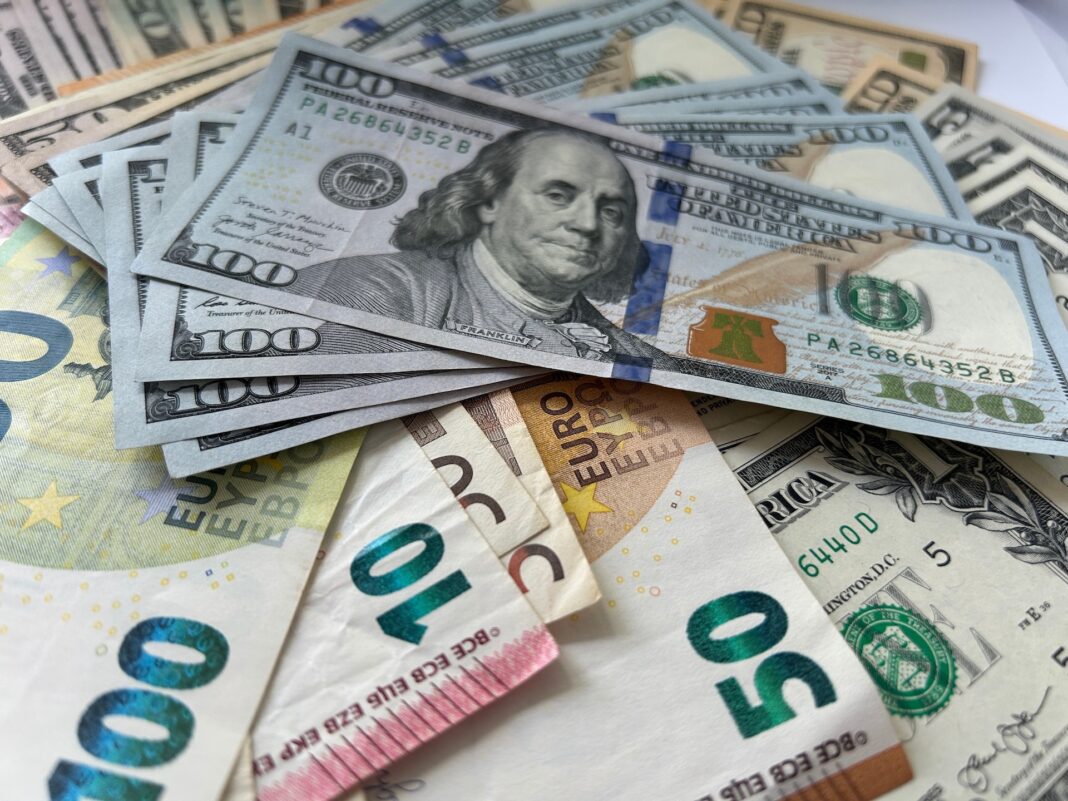
Exchange rates influence almost every corner of the global economy, from the cost of imported goods and international travel to corporate profits and investment returns. Yet currency movements can appear unpredictable. Why does the euro weaken when the European Central Bank announces an interest rate decision? Why does the US dollar sometimes strengthen during a financial crisis, even when the American economy faces serious challenges?
Understanding the forces behind currency prices starts with a simple exchange rate definition. From there, investors can examine how interest rates, international trade, capital flows and market sentiment interact to determine the value of one currency against another.
Exchange Rate Definition: What Is an Exchange Rate?
The simplest exchange rate definition is the price of one currency expressed in terms of another. An exchange rate tells us how much of one currency is required to purchase a unit of a different currency.
For example, if the EUR/USD exchange rate is 1.1000, one euro is worth 1.10 US dollars. Someone exchanging €1,000 would therefore receive $1,100 before transaction costs.
Exchange rates are determined in the foreign exchange market, commonly known as forex or FX, where banks, financial institutions, businesses, governments and individual investors exchange currencies.
According to the Bank for International Settlements (BIS), average daily foreign exchange trading reached approximately $9.6 trillion in April 2025. The US dollar was involved in roughly 89% of transactions, demonstrating its central role in global financial markets.
Unlike stocks, currencies are always valued relative to another currency. The euro does not simply rise or fall in isolation. It appreciates or depreciates against the dollar, the pound, the yen or another currency.
This distinction is essential because the same currency can strengthen against one trading partner while weakening against another.
Read also: Fiat Currency Explained: Why Modern Money Has Value Without Commodity Backing
Understanding Base Currency and Quote Currency
Every foreign exchange quotation contains two currencies. The first is called the base currency, while the second is known as the quote currency.
Consider the EUR/USD currency pair:
- EUR: Base currency, representing the euro.
- USD: Quote currency, representing the US dollar.
- 1.1000: The amount of US dollars needed to purchase one euro.
The quotation follows a straightforward rule: one unit of the base currency equals a specified number of units of the quote currency.
If EUR/USD increases from 1.1000 to 1.1200, the euro has appreciated against the dollar. It now takes more dollars to purchase one euro.
Conversely, if EUR/USD falls to 1.0800, the euro has depreciated because fewer dollars are needed to buy it.
The CME Group’s explanation of foreign exchange quotation conventions provides further examples of how currency pairs are structured and interpreted.
An important detail is that exchange rate movements are reciprocal. If EUR/USD rises, the euro strengthens against the dollar, while the dollar weakens against the euro.
Floating vs. Managed Exchange Rates: Who Determines Currency Prices?
Not every currency follows the same exchange rate system. Governments and central banks adopt different approaches depending on their economic priorities.
Floating Exchange Rates
Under a floating exchange rate system, the currency’s value is primarily determined by market supply and demand.
The US dollar, euro, British pound and Japanese yen operate under floating exchange rate regimes.
Their prices respond to economic developments, monetary policy expectations and changes in investor demand.
For example, stronger demand for euro-denominated assets can encourage investors to purchase euros, potentially pushing the currency higher.
Although central banks influence exchange rates indirectly through monetary policy, they generally do not maintain a specific exchange rate target under a freely floating system.
The European Central Bank (ECB), for instance, explains that the euro’s exchange rate is not a monetary policy target.
Managed and Fixed Exchange Rates
Under a managed exchange rate system, authorities actively influence the currency’s value, even when market forces continue to play a role.
A central bank might purchase its domestic currency using foreign exchange reserves to support its value. Alternatively, it could sell domestic currency to reduce appreciation pressure.
A fixed exchange rate system goes further by linking a currency to another currency or a basket of currencies at a predetermined rate or within a narrow range.
Maintaining such arrangements may require foreign exchange interventions, interest rate adjustments or other policy measures.
The International Monetary Fund (IMF) notes that exchange rate management can help countries respond to economic shocks, although intervention creates important trade-offs for monetary policy independence and financial stability.
The practical difference is that floating currencies respond more directly to market conditions, while managed currencies are also influenced by explicit policy decisions.
What Actually Moves an Exchange Rate?
Currency prices reflect the interaction of several economic and financial forces. Although individual factors can explain short-term movements, their combined effect determines the broader direction of a currency pair.
1. Interest Rate Differentials and Central Bank Policy
Interest rates are among the most closely watched drivers of foreign exchange markets.
When a central bank raises interest rates, assets denominated in its currency may become more attractive to international investors.
Higher yields on government bonds or bank deposits can increase demand for the currency, potentially supporting its value.
However, investors rarely examine a country’s interest rates in isolation. They focus on the interest rate differential, meaning the difference between interest rates in two economies.
Suppose the Federal Reserve maintains its policy rate at 4%, while the European Central Bank keeps its rate at 2%.
The two-percentage-point difference may encourage some investors to hold dollar-denominated assets rather than euro-denominated alternatives.
This can create upward pressure on the US dollar relative to the euro.
But the relationship is not automatic.
Investors also consider expected exchange rate movements, inflation, credit risk and future interest rate decisions. A currency offering higher yields can still depreciate enough to eliminate the interest advantage.
Research published by the Federal Reserve highlights another important consideration: unexpected changes in monetary policy expectations tend to matter more than decisions already anticipated by markets.
In other words, a central bank can raise interest rates without strengthening its currency if investors were already expecting an even larger increase.
2. Trade Flows and International Demand for Currency
International trade creates continuous demand for foreign currencies.
When a European company imports machinery from the United States and pays in dollars, it may need to exchange euros for dollars.
This transaction increases demand for dollars and the supply of euros in the foreign exchange market.
Conversely, when an American importer purchases European products priced in euros, it may need to buy euros to complete the transaction.
Over time, exports, imports and cross-border payments can influence exchange rates.
A country experiencing strong export demand may benefit from increased demand for its currency, particularly when foreign customers must purchase that currency to settle transactions.
However, trade balances alone cannot explain exchange rate movements.
A country can run a trade deficit while maintaining a strong currency if international investors are simultaneously purchasing its government bonds, equities, property or other financial assets.
Capital flows can therefore offset, or even outweigh, the effects of international trade.
Read also: Rollercoin Review: Fun Cryptocurrency Mining Through Gaming
3. Capital Flows and Investment Decisions
Financial investment is another major source of currency demand.
Imagine a large American investment fund deciding to purchase European government bonds.
To complete the transaction, the fund may need to convert dollars into euros, increasing demand for the European currency.
The reverse occurs when European investors purchase American financial assets without using currency hedges.
These capital movements can be influenced by expected investment returns, economic growth, political stability and financial market valuations.
Importantly, investors do not always need to physically exchange currencies for every individual investment transaction. Currency hedging arrangements and existing foreign currency balances can alter the immediate impact.
Nevertheless, international portfolio decisions remain an important influence on exchange rates.
4. Inflation and Economic Growth
Inflation affects a currency’s purchasing power and can influence its long-term value.
If prices in one country rise substantially faster than those in its trading partners, its goods may become less competitive internationally.
Over time, this can contribute to depreciation pressure, although the relationship is affected by productivity, monetary policy and capital flows.
Economic growth also matters.
Stronger growth can attract foreign investment, increasing demand for domestic assets and potentially supporting the currency.
But positive economic data do not guarantee appreciation. For example, rapid growth accompanied by high inflation or unsustainable borrowing may cause investors to reassess a country’s economic outlook.
Currency markets therefore respond not only to economic performance itself but also to whether that performance exceeds or disappoints expectations.
5. Risk Sentiment and Safe-Haven Demand
During periods of financial uncertainty, investors often reduce their exposure to assets perceived as risky.
This shift is commonly described as a move from risk-on to risk-off sentiment.
Risk-on conditions typically encourage investment in equities, emerging markets and higher-yielding currencies.
Risk-off conditions can increase demand for currencies traditionally viewed as relatively safe or liquid, particularly the US dollar and Swiss franc.
The Japanese yen has also frequently benefited from safe-haven demand, although its behavior varies with interest rate differentials and the nature of the market shock.
The dollar’s international role is especially important.
Many financial institutions, corporations and governments hold dollar-denominated assets and liabilities. During periods of financial stress, demand for dollar liquidity can increase sharply.
As a result, the dollar may appreciate even when uncertainty originates partly in the United States.
However, safe-haven behavior is not guaranteed. Currency reactions depend on the specific crisis, investor positioning and expectations about the policy response.
Practical Example: Why EUR/USD Moves From 1.1000 to 1.0800
To understand how these forces translate into actual exchange rate movements, consider a hypothetical example involving the euro and US dollar.
Assume EUR/USD initially trades at 1.1000.
At this exchange rate:
€1 = $1.10
€1,000 = $1,100
Now suppose new economic data indicate that inflation in the United States is proving more persistent than investors expected.
Financial markets begin anticipating that the Federal Reserve will maintain higher interest rates for longer, while the ECB may reduce borrowing costs sooner.
This change in expectations increases the relative attractiveness of dollar-denominated assets.
Investors respond by increasing demand for dollars, putting downward pressure on EUR/USD.
The exchange rate subsequently falls to 1.0800.
At the new exchange rate:
€1 = $1.08
€1,000 = $1,080
The euro has lost approximately 1.82% of its value against the dollar.
The calculation is:
(1.0800 − 1.1000) / 1.1000 × 100 = −1.82%
Meanwhile, measured in euros, the dollar has appreciated by approximately 1.85%. The percentages differ slightly because the two movements are calculated using reciprocal exchange rates.
The consequences depend on who is exchanging money.
A European investor holding $10,000 would see the euro value of that investment increase from approximately €9,091 to €9,259, assuming the dollar value of the underlying asset remained unchanged.
An American investor holding €10,000 would experience the opposite effect, with the dollar value declining from $11,000 to $10,800.
This example illustrates why exchange rate movements matter even when investors are not actively trading forex.
Note: All exchange rates and monetary policy assumptions in this example are hypothetical and do not represent current market quotations.
Why Exchange Rates Sometimes Move Against Economic Logic
Investors frequently expect strong economic data to strengthen a currency and weak data to cause depreciation.
In practice, the relationship is more complicated.
Currency markets are forward-looking. Prices reflect expectations about future developments rather than simply reacting to current economic conditions.
Suppose analysts expect inflation to reach 3.5%, but the published figure comes in at 3.2%.
Although inflation remains relatively high, the lower-than-expected reading could encourage investors to anticipate faster interest rate cuts.
The currency might weaken despite inflation still exceeding the central bank’s target.
Similarly, a surprisingly weak economic report can strengthen a currency if investors interpret it as reducing financial instability or changing the outlook for competing economies.
This helps explain why exchange rates can move sharply following central bank announcements, employment reports, inflation releases or geopolitical developments.
As the CFA Institute explains, forecasting exchange rates is exceptionally difficult because currency prices reflect numerous interacting variables.
Exchange Rates and Investment Returns
Exchange rate fluctuations are particularly important for investors holding foreign assets.
Consider a European investor purchasing American shares.
The investment’s performance depends on two separate factors: the price movement of the shares and the exchange rate between the dollar and euro.
Suppose the American shares appreciate by 10% in dollar terms, while the dollar depreciates by 8% against the euro.
The investor’s return in euros would be approximately 1.2%, before fees and taxes, rather than the full 10% generated by the shares.
The calculation is:
1.10 × 0.92 − 1 = 1.2%
Conversely, dollar appreciation could increase the euro-denominated return.
This is why international investors often consider currency risk alongside market risk.
Some investment funds use currency hedging to reduce the effect of exchange rate fluctuations. However, hedging introduces costs and its effectiveness depends on the instrument, interest rate differentials and market conditions.
For long-term investors, the decision to hedge depends on their objectives, investment horizon and tolerance for currency volatility.
How Can Investors Monitor Exchange Rate Movements?
Understanding currency movements does not require forecasting every market fluctuation.
A useful starting point is monitoring central bank announcements, changes in interest rate expectations, inflation data and major economic releases.
Investors should also follow international capital flows, geopolitical developments and broader financial market sentiment.
Official exchange rate data can be obtained from the European Central Bank’s exchange rate database, which publishes reference rates for the euro against numerous currencies.
These reference rates provide a useful benchmark, although actual transaction prices can differ because of bid-ask spreads, service fees and market conditions.
Investors comparing exchange services should therefore distinguish between the market exchange rate and the rate ultimately offered by a bank, broker or payment provider.
Conclusion: Exchange Rates Reflect Relative Economic Expectations
The key principle behind any exchange rate definition is that currencies have relative rather than independent values.
A currency pair reflects the evolving relationship between two economies, their monetary policies, investment opportunities and perceived financial risks.
Interest rate differentials can attract investment capital, trade flows generate currency demand, and shifts in global risk sentiment can quickly change market preferences.
Yet no single indicator consistently determines the direction of an exchange rate.
For investors, the goal should not necessarily be to predict the next currency movement. A more practical approach is to understand which factors influence exchange rates, how currency exposure affects investment performance and when exchange rate fluctuations may create additional risks or opportunities.
Ultimately, an exchange rate is more than a number on a trading screen. It is a constantly changing market price that reflects how investors, businesses and institutions assess the relative value of two currencies.