


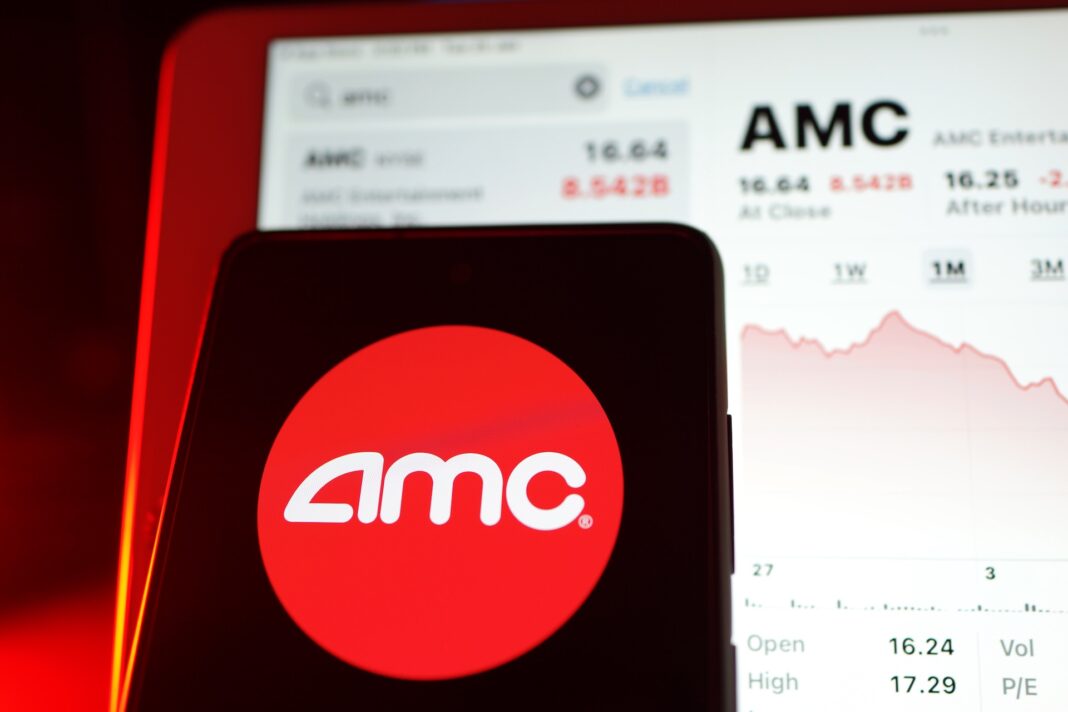
AMC Entertainment is once again attracting attention from investors. The cinema chain has delivered the strongest quarterly revenue and adjusted EBITDA in its 106-year history, its stock has recovered sharply from the lows reached earlier in 2026, and bullish traders are once again discussing the possibility of an AMC short squeeze.
There is, however, one major difference between today’s market environment and the conditions traditionally associated with an explosive squeeze: AMC’s short interest has fallen dramatically.
According to the latest AMC short-interest data from MarketBeat, approximately 49.6 million AMC shares were sold short as of July 15, 2026, representing roughly 5.6% of the public float. Days to cover stood at just 1.12 days.
Earlier in 2026, the situation looked very different. On February 27, more than 124 million AMC shares were sold short, equivalent to approximately 20.4% of the float, while days to cover stood at 4.2.
At the same time, the company’s underlying business has improved substantially. AMC’s second-quarter 2026 financial results showed revenue of almost $1.6 billion and adjusted EBITDA of $321.4 million.
The result is an unusual setup: the fundamental argument for AMC has strengthened just as the technical conditions for a traditional short squeeze have weakened.
So, could another AMC squeeze still happen?
Read also: SpaceX IPO: The Space Race on the Stock Market and How to Invest Before the Next Big Lift-Off
AMC short squeeze: where does the stock stand now?
AMC shares closed at $2.75 on July 29, 2026, marking their third consecutive session of gains, according to MarketWatch market data.
The recovery has been substantial. AMC disclosed in a June securities filing that its stock had fallen as low as $0.93 intraday on March 27, 2026. AMC’s SEC prospectus therefore shows just how significant the subsequent rebound has been.
Investors searching for an AMC short squeeze, however, should distinguish between three different forces capable of driving a stock higher.
Fundamental repricing occurs when investors conclude that AMC deserves a higher valuation because revenue, cash generation and profitability are improving.
Momentum buying occurs when investors buy primarily because the stock is already rising, potentially amplifying trading volume and volatility.
A short squeeze, by contrast, happens when rising prices force investors who have sold shares short to close their positions by buying shares back. Those purchases create additional demand and can accelerate an existing rally.
AMC can theoretically experience all three simultaneously. But current short-interest figures suggest that short covering alone has significantly less potential to create an extraordinary move than it did earlier in 2026.
AMC short interest has fallen sharply
The development of short interest is arguably the most important component of the current AMC short squeeze analysis.
According to MarketBeat’s historical AMC short-interest statistics:
| Reporting date | Shares sold short | Short % of float | Days to cover |
| February 27, 2026 | 124.1 million | 20.4% | 4.20 |
| March 13, 2026 | 118.1 million | 22.4% | 4.15 |
| March 31, 2026 | 88.9 million | 10.0% | 3.65 |
| April 30, 2026 | 106.2 million | 17.4% | 3.18 |
| May 15, 2026 | 63.3 million | 10.4% | 2.24 |
| May 29, 2026 | 59.1 million | 9.7% | 2.36 |
| June 15, 2026 | 58.2 million | 9.5% | 1.28 |
| June 30, 2026 | 52.9 million | 6.0% | 0.86 |
| July 15, 2026 | 49.6 million | 5.6% | 1.12 |
The trend is significant.
Between February 27 and July 15, the number of AMC shares sold short declined by roughly 60%. Short interest as a percentage of float fell from more than 20% to below 6%.
That makes the current setup materially different from a classic high-short-interest squeeze candidate.
Why Days to Cover matters for an AMC squeeze
Days to Cover, usually abbreviated DTC, estimates how many trading days would theoretically be required for short sellers to repurchase all shares currently sold short based on average trading volume.
The calculation is relatively simple:
Days to Cover = Shares sold short ÷ Average daily trading volume
MarketBeat currently reports approximately 49.6 million AMC shares sold short and average volume of roughly 39.4 million shares, resulting in a short-interest ratio of around 1.1 days.
For investors looking for potential squeeze candidates, higher DTC values are generally more notable.
Imagine that a company has ten days to cover. Short sellers attempting to exit simultaneously would theoretically have to account for a significant proportion of normal trading demand for several sessions.
At approximately one day to cover, the situation is considerably less restrictive.
That does not make an AMC squeeze impossible. An unexpected catalyst can cause price, trading volume and short covering to increase simultaneously. But a DTC ratio around 1.1 does not currently indicate an especially severe liquidity constraint for AMC short sellers.
This is one of the strongest arguments against assuming that another 2021-style squeeze is imminent.
Read also: Yrefy Investment Review: High Fixed Returns, Private Student Loan Debt and the Risks Investors Should Know
AMC’s expanding share count changes the squeeze equation
Short covering is not the only factor behind AMC’s changing market structure.
AMC has repeatedly issued new shares to strengthen its balance sheet.
On June 11, the company announced the completion of a $150 million at-the-market equity offering. AMC said approximately 105.3 million shares had been sold through the program. The details are available in AMC’s announcement of the completed ATM offering.
Later in June, AMC raised another approximately $200 million through a registered direct offering to institutional investors. According to the company’s offering announcement, AMC sold 95.25 million shares at $2.10 per share.
AMC subsequently confirmed that the $200 million offering had closed and said a large part of the proceeds would be used to redeem its 6.125% Senior Subordinated Notes due in 2027.
Equity issuance has two opposing consequences.
On the positive side, AMC receives additional capital that can strengthen liquidity, reduce debt and lower financial risk.
On the negative side, issuing new shares dilutes existing shareholders.
For the AMC short squeeze thesis, the larger number of tradable shares matters for another reason: a bigger float can provide additional liquidity, potentially making it easier for short sellers to close their positions.
AMC’s fundamentals are finally improving
The bullish AMC thesis is no longer dependent solely on meme-stock enthusiasm.
According to AMC’s official second-quarter results, revenue increased 14.2% year over year to $1.5967 billion.
Adjusted EBITDA climbed 69.6% to $321.4 million, compared with $189.5 million during the same period a year earlier.
Operating cash flow reached $235.4 million, while AMC generated $190.1 million in free cash flow during the quarter.
Cash and cash equivalents stood at $778.4 million at the end of June, excluding restricted cash.
These are meaningful improvements for a company whose leverage and liquidity have represented major concerns for investors since the pandemic.
AMC also said its refinancing and capital-market transactions mean it currently anticipates no material debt maturities before 2029.
That matters to short sellers.
If rising cinema attendance translates into sustained cash generation while AMC continues reducing its debt burden, one of the most important components of the bearish AMC thesis becomes less convincing.
This does not automatically cause a squeeze. But improving fundamentals can encourage remaining short sellers to reconsider whether maintaining their positions is worth the risk.
Record EBITDA does not mean AMC’s problems have disappeared
The results still require context.
Despite record adjusted EBITDA, AMC reported a GAAP net loss of $11.4 million in the second quarter, equivalent to a diluted loss of $0.02 per share, according to the company’s Q2 financial report.
AMC also remains highly leveraged.
And for shareholders, perhaps the most important issue is dilution.
The company has repeatedly demonstrated that it is prepared to raise equity when management believes doing so can improve AMC’s financial position.
This creates an important contradiction for the squeeze thesis.
A rising stock price can make an AMC squeeze more likely by putting pressure on short sellers. But the same higher share price can provide AMC with a more attractive opportunity to raise additional capital.
In other words, a rally itself could increase the economic attractiveness of issuing additional shares.
AMC stock price prediction: bullish scenario
Any AMC stock price prediction should separate the company’s fundamental valuation from the possibility of a temporary speculative squeeze.
A bullish scenario would probably require several developments to occur together:
- strong U.S. and international box-office performance;
- sustained positive free cash flow;
- further improvement in profitability;
- continued debt reduction;
- limited additional dilution;
- rising investor interest and trading volume;
- and potentially renewed growth in short interest ahead of a positive catalyst.
Under a conventional bullish scenario, AMC could potentially trade in the $3.50–$4.50 range over the next 12 months.
That would also place the stock around or slightly above the upper end of current analyst expectations.
The latest Wall Street AMC price targets compiled by MarketBeat show an average target of $2.53, with estimates ranging from $1.20 to $4.00.
Several analysts became more optimistic following AMC’s Q2 results. Wedbush increased its target from $3 to $4, while Benchmark raised its target from $2.50 to $3.
A genuine short squeeze could temporarily push AMC considerably beyond conventional analyst targets.
However, the current combination of roughly 5.6% short interest and a 1.1-day short ratio does not provide strong evidence for incorporating such an event into a normal base-case valuation.
Extreme bullish scenario: what could trigger another AMC squeeze?
For an aggressive AMC squeeze scenario to become substantially more credible, investors should watch several indicators together rather than simply monitoring the stock price.
1. Short interest rises again
Short interest returning toward 15–20% of the float would create significantly more potential forced buying if AMC began rising rapidly.
2. Days to cover increases
A move in DTC from around one day toward three, four or five days would suggest that the short position was becoming much larger relative to normal trading liquidity.
3. AMC delivers another major catalyst
Another significant earnings beat, exceptional box-office performance, major debt reduction or sustained profitability could initiate buying pressure.
4. Trading volume accelerates
AMC has historically attracted enormous levels of retail trading activity. Strong price appreciation combined with rapidly expanding volume would suggest that momentum investors were returning.
5. Short sellers start covering
This produces the actual squeeze feedback loop:
Higher price → short covering → additional buying → higher price → more short covering.
Under such unusual conditions, a temporary move above $5 cannot be excluded.
It should not, however, be interpreted as a conventional AMC stock price prediction. It would represent an event-driven speculative scenario rather than a fundamental valuation.
AMC stock price prediction: base case
The base case is considerably less dramatic.
AMC’s operating performance is materially stronger than it was one year ago. Its latest results demonstrate the significant operating leverage cinemas can generate when attendance and box-office revenue increase.
Its immediate balance-sheet situation has also improved.
But AMC continues to carry substantial debt, remains dependent on the Hollywood release calendar and has dramatically expanded its share count.
Those factors are likely to constrain valuation.
A reasonable scenario-based AMC stock price prediction would therefore be approximately $2.40–$3.30 in the base case over the next 12 months, assuming the operating recovery continues without creating another speculative mania.
For comparison, the current analyst consensus compiled by MarketBeat stands at approximately $2.53 per share.
AMC stock price prediction: bearish scenario
There is also a credible bearish case.
Potential negative catalysts include:
- weaker-than-expected movie releases;
- declining cinema attendance;
- deterioration in free cash flow;
- persistent interest costs;
- additional equity issuance;
- or a slower industry recovery.
AMC benefits from significant operating leverage when revenue increases, but the same structure works in reverse. Lower attendance can quickly pressure profitability because cinemas carry substantial fixed costs.
Under a bearish scenario, a decline toward approximately $1.50–$2.00 would be plausible.
In a more severe combination of weak box-office results, worsening cash generation and further dilution, the stock could potentially fall lower.
Bull vs. bear AMC scenario
| Scenario | Key assumptions | Possible price range |
| Bear case | Box office weakens, cash flow deteriorates, further dilution | $1.50–$2.00 |
| Base case | Recovery continues and debt gradually declines | $2.40–$3.30 |
| Bull case | Strong box office, profitability and deleveraging | $3.50–$4.50 |
| Short-squeeze scenario | Rising short interest + major catalyst + extreme volume | $5+ temporarily possible |
These ranges represent scenarios rather than guaranteed price targets. AMC remains a highly volatile stock, and meme-stock trading can push prices significantly above or below levels justified by traditional valuation models.
The biggest obstacle to an AMC short squeeze
For traders specifically looking for another AMC short squeeze, the weakest part of the current setup is not AMC’s revenue or even its debt.
It is short interest.
Historical short-interest data show that more than one-fifth of AMC’s float was sold short at certain points earlier in 2026.
By July 15, that figure had fallen to approximately 5.6%.
Days to cover simultaneously declined from more than four days in February and March to only around one day.
There are therefore fewer outstanding short positions that could be forced to close, while trading liquidity relative to those positions has improved.
Ironically, AMC’s improving fundamental outlook may itself have contributed to shorts reducing their exposure.
Investors searching for evidence of another squeeze should therefore not simply ask whether AMC’s stock price is rising.
The more important question is whether short interest begins growing faster than market liquidity.
That combination could transform an ordinary rally into a much more volatile event.
Is another AMC short squeeze possible in 2026?
Yes. But current data does not suggest that a major squeeze is inevitable.
AMC still has several characteristics that can support speculative rallies: an enormous retail-investor following, historically high trading activity, strong brand recognition among meme-stock traders and improving operating results.
The company’s fundamental position has also strengthened significantly.
Its record second-quarter results included almost $1.6 billion in revenue, $321.4 million in adjusted EBITDA, positive operating cash flow and $190.1 million in quarterly free cash flow.
At the same time, AMC has improved its near-term debt maturity profile through refinancing and equity issuance.
But a traditional short squeeze requires one crucial ingredient: a substantial number of short sellers.
Compared with early 2026, there are currently far fewer of them.
The most important indicators investors should therefore monitor are short interest as a percentage of float, total shares sold short, Days to Cover, trading volume, additional equity issuance, free cash flow and debt reduction.
If AMC’s short interest begins climbing substantially while its fundamental performance continues improving, the probability of another AMC squeeze would increase.
Until that happens, the more compelling AMC story may be the company’s attempted financial recovery rather than a repeat of 2021.