


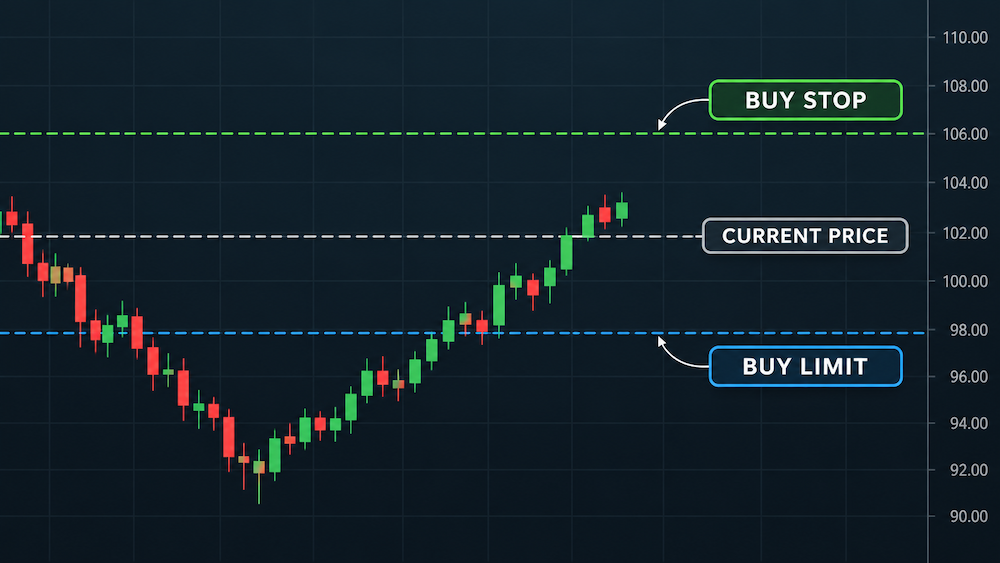
Two investors want to buy the same stock, currently trading at $100. One places an order at $95, hoping to purchase it at a lower price. The other places an order at $105, waiting for the stock to demonstrate upward momentum before entering the market. Both intend to buy, but their orders work in fundamentally different ways. Understanding buy limit vs buy stop is essential for controlling entry prices, managing execution risk, and avoiding costly trading mistakes.
Although these orders may appear similar on a trading platform, they serve different purposes. A buy limit order establishes the maximum price an investor is willing to pay. A buy stop order activates a purchase only after the market reaches a specified higher price. The distinction becomes particularly important during volatile trading sessions, when prices can move beyond expected levels before an order is executed.
Buy Limit vs Buy Stop: Understanding the Difference
The simplest way to distinguish these orders is by considering their position relative to the current market price.
A buy limit order is typically placed below the current market price. It allows an investor to purchase an asset at the specified price or lower, but execution is not guaranteed.
A buy stop order, by contrast, is placed above the current market price. It becomes active when the market reaches the stop price. A standard buy stop then turns into a market order, meaning the final purchase price may be higher than the level originally specified.
This distinction is also reflected in the US Securities and Exchange Commission’s explanation of order types, which distinguishes between the price protection offered by limit orders and the triggering mechanism used by stop orders. investor.gov
In practical terms, a buy limit expresses the intention to purchase at a more attractive price, while a buy stop expresses the intention to purchase only after a particular upward price movement.
How a Buy Limit Order Works
A buy limit order allows investors to establish the maximum acceptable purchase price before entering a trade.
Suppose a stock is trading at $100, but an investor considers $95 a more attractive entry point. Instead of purchasing immediately, the investor submits a buy limit order at $95.
If the market subsequently declines, the order becomes eligible for execution when shares are available at $95 or less. If the stock continues trading above that level, the investor may never acquire the shares.
This approach is commonly associated with buying during price corrections, accumulating positions at predetermined valuations, or entering trades near technical support levels.
For example, an investor might believe that a stock is fundamentally attractive but temporarily overpriced. By placing a buy limit below the current price, the investor can establish a disciplined entry level rather than responding emotionally to short-term fluctuations.
However, one assumption frequently causes confusion: a buy limit order does not guarantee execution simply because a chart shows the limit price being touched.
An order may remain unfilled because other participants have priority in the order book, insufficient shares are offered at the required price, or the relevant market quotation does not satisfy the execution conditions.
There is also an investment risk unrelated to order execution. A stock that falls from $100 to $95 may continue declining to $90, $80, or lower. Buying at a discount to the previous market price does not necessarily mean buying an undervalued asset.
Read also: Robotics Stocks: A Framework for Finding Real Automation Exposure
How a Buy Stop Order Works
A buy stop order takes a different approach. Instead of waiting for a lower price, the investor waits for the market to rise to a predefined level.
Imagine that a stock is trading at $100 and has repeatedly struggled to move above $104. An investor believes that a sustained move beyond $105 could indicate stronger buying interest.
The investor places a buy stop order at $105.
If the relevant market price reaches the specified trigger, the standard buy stop converts into a market buy order. It then attempts to purchase shares at the available market prices.
This strategy is often used by traders who follow momentum or breakout strategies. Rather than purchasing before a possible upward movement, they wait for the price to reach a level that supports their trading thesis.
There is another important application: managing short positions.
An investor who has sold a stock short may place a buy stop above the current market price to repurchase shares if the stock rises. The intention is to prevent losses from increasing indefinitely as the market moves against the short position.
Both applications are recognized in Charles Schwab’s educational guide to order types. Charles Schwab
However, a buy stop does not guarantee a purchase at the stop price. That price determines when the order activates, not necessarily what the investor pays.
Buy Limit vs Buy Stop: Two Different Trading Strategies
The decision between a buy limit and a buy stop depends less on whether an investor expects prices to rise over the long term and more on the conditions under which the investor wants to enter the market.
A buy limit is generally associated with a pullback strategy. The investor expects that the asset may temporarily decline and wants to purchase at a predetermined price.
A buy stop is commonly associated with momentum confirmation. The investor is willing to pay more than the current market price, but only if the asset first reaches a selected level.
Neither approach is inherently superior.
For example, a trader using a buy limit may purchase at $95 only to watch the stock decline to $85. Meanwhile, a trader using a buy stop at $105 may enter after a breakout that quickly reverses, leaving the stock trading below $100.
The first investor faces the risk of buying into a continuing decline. The second faces the risk of buying into a failed breakout.
In both cases, the order type controls how the trade is initiated. It does not determine whether the investment decision will ultimately prove profitable.
What Happens When Prices Gap? The Risk Investors Often Overlook
Price gaps are one of the most important considerations when comparing buy limit vs buy stop orders.
A price gap occurs when an asset moves from one price level to another without trading at every intermediate price. This can happen around earnings announcements, economic data releases, unexpected corporate news, or the reopening of a market after a trading session.
Consider the same stock trading at $100, with a buy limit at $95 and a buy stop at $105.
If the company unexpectedly announces excellent financial results after the market closes, the stock might open the following session at $112.
The buy stop at $105 may then activate because the market has moved beyond the trigger level. But the resulting market order does not necessarily execute at $105.
If the next available purchase price is $112.50, that could become the execution price.
For an order involving 100 shares, the difference is substantial. Purchasing at $105 would cost $10,500, while purchasing at $112.50 would cost $11,250. That represents an additional $750 compared with the intended stop level.
This is an example of slippage, where the actual execution price differs from the anticipated price.
Now consider the opposite situation.
If disappointing company news causes the stock to open at $92, the buy limit at $95 may execute at $92 or another available price no higher than $95, provided the order’s conditions are satisfied.
The distinction is crucial: a buy limit protects the maximum purchase price, while a standard buy stop does not.
The SEC specifically warns in its investor bulletin on stop and stop-limit orders that a stop price is not a guaranteed execution price. The final result depends on available liquidity and prevailing prices after activation.
Does a Buy Stop Limit Order Solve the Slippage Problem?
Investors concerned about paying significantly more than expected may consider a buy stop limit order.
This combines two instructions. The stop price determines when the order becomes active, while the limit price establishes the maximum acceptable purchase price.
For example, an investor might place a buy stop limit with a stop price of $105 and a limit price of $106.
When the stop condition is satisfied, the order becomes a buy limit order that can execute at $106 or less.
This introduces price protection that a standard buy stop does not provide. However, it creates another risk: the order might not execute at all.
If the stock jumps directly from $100 to $112, the buy stop limit could activate but remain unfilled because the market is trading above the $106 limit.
For a trader attempting to protect a short position, this could be especially problematic. The investor may remain exposed to further losses despite the stop limit having been triggered.
Consequently, a stop limit offers price protection at the expense of execution certainty. It does not eliminate trading risk; it changes the type of risk the investor accepts.
Common Misconceptions About Buy Limit and Buy Stop Orders
One frequent mistake is assuming that a buy stop guarantees execution at the selected stop price. In reality, its primary purpose is to activate a market order once the trigger condition is met. A fast-moving market may produce a considerably higher purchase price.
Another misconception is that a buy limit always executes when the last traded price reaches the limit. Execution depends on actual available offers, market liquidity, order priority, and trading conditions. A price appearing on a chart does not automatically mean that every investor waiting at that level has received a fill.
Investors also sometimes assume that both order types operate identically across all brokers and markets.
In practice, trading platforms may use different methods to determine when a stop order activates. Some rely on the last traded price, while others use bid or ask quotations. Orders may also be subject to restrictions outside regular trading hours.
These differences matter particularly in volatile or less-liquid securities, where the quoted bid and ask may be separated by a wide spread.
The Interactive Brokers documentation confirms that stop orders can execute substantially away from their trigger prices and that the order becomes a market instruction once activated. Interactive Brokers FAQ
There is also a practical mistake worth avoiding: placing a buy limit and a buy stop simultaneously without considering what happens if both eventually execute. Unless the broker supports a linked arrangement that automatically cancels the remaining order, both could result in purchases.
Read also: What Stocks Pay Dividends? How to Identify Sustainable Payers
Which Order Should Investors Choose?
The answer depends on the investor’s strategy and the trade-off between price control and participation in a market movement.
An investor who prioritizes paying no more than a particular amount will generally find a buy limit more appropriate. It establishes an upper purchase-price boundary, although the market may never provide an opportunity to execute the order.
A trader who wants to enter only after an upward price movement may prefer a buy stop. This allows the order to remain inactive until the specified market condition is met, but introduces uncertainty over the final purchase price.
The choice should also account for liquidity, volatility, trading hours, and the potential consequences of unexpected news.
For long-term investors, a limit order can be useful when building positions at specific valuations. For active traders, a buy stop can support a breakout strategy or help manage exposure from a short position.
Neither removes the need for a coherent investment strategy or appropriate risk management.
Conclusion: The Difference Is Price Control vs. Triggered Entry
Understanding buy limit vs buy stop comes down to recognizing two distinct instructions.
A buy limit order tells the market the maximum price an investor is prepared to pay. A buy stop order tells the broker when to activate a purchase after the price reaches a higher level.
The price ladder makes this distinction clear: with a stock trading at $100, a buy limit at $95 seeks a cheaper entry, while a buy stop at $105 waits for upward price movement.
But execution matters just as much as order placement. A limit order can remain unfilled, and a stop order can execute substantially above its trigger price.
For investors, the most important question is therefore not simply whether they expect an asset to rise. It is whether they want to prioritize the price they pay or the market condition that initiates their purchase.
Disclaimer: This article is for educational purposes only and does not constitute investment advice. All price examples are hypothetical. Order availability, triggering conditions and execution policies may vary by broker, exchange and financial instrument.