


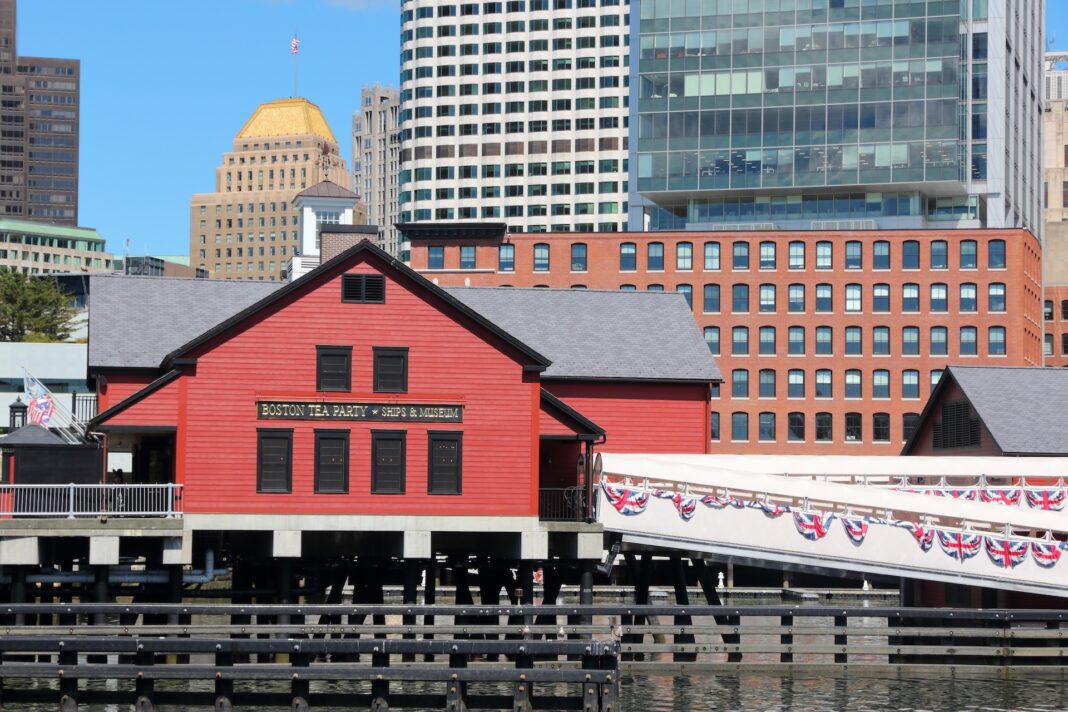
In December 1773, American colonists disguised as Native Americans boarded ships of the British East India Company in Boston Harbor and threw 342 chests of tea into the sea. They were reacting to the Tea Act, which allowed the company to sell tea in the colonies under favorable conditions, effectively granting it a monopoly.
For the colonists, this was not just a symbol of unfair taxation, but clear evidence that the British government was interfering in the market in a way that destroyed fair competition.
The Boston Tea Party of 1773 is often presented as the symbolic beginning of the American Revolution. In reality, however, it was much more than a political protest. The event, in which colonists dumped hundreds of chests of tea into the sea, was primarily a response to market distortion, monopolistic practices, and state intervention in the economy. It was at this moment that the principles on which modern capitalism and investing stand began to take shape.
Local merchants were pushed out of the market, and ordinary consumers found themselves in a situation with no real choice. The protest was therefore not only ideological but also economic. Colonists rejected a system that favored one company at the expense of others.
The First “Market Protest” in a Modern Sense
When a group of colonists destroyed 342 chests of tea in December 1773, it was not an act of random vandalism, but an organized economic protest against the combination of taxation and the monopoly position of a single company.
From today’s perspective, this event can be understood as one of the first cases in which consumers and merchants actively stood against market distortion. In essence, the colonists did what investors and consumers do today when dissatisfied — they rejected both the product and the system behind it.
Read also: How Much to Invest Monthly to Become a Millionaire
From Monopoly to Capitalism
The Boston Tea Party triggered a chain of events that led to the American Revolution and the creation of a new state. That state then began to form on principles that stood in direct contrast to the British model — emphasizing free markets, the protection of private property, and limits on government intervention.
As noted by Law & Liberty, economic tensions and disputes over control of trade played a key role in escalating the conflict. The emerging United States subsequently became one of the first modern environments where capitalism could develop in a relatively “pure” form.
The Birth of Investment Thinking
In the long run, this event also had a profound impact on how people think about money and investing. After the founding of the United States, a financial system began to develop based on trust in markets, entrepreneurship, and capital.
Principles that we now consider fundamental — such as competition, transparency, and resistance to monopolies — have their roots in historical conflicts like this one. The colonists sent a clear signal: a market must be fair, otherwise it loses its legitimacy.
Trust as the Foundation of Markets
One of the most important legacies of the Boston Tea Party is the relationship between trust and the functioning of markets. The event became a symbol of resistance against economic control and a reminder that markets primarily rely on the trust of their participants.
If people feel that a system is unfair or manipulated, they react — whether by leaving the market, boycotting, or in extreme cases, through revolution.
Read also: WalletInvestor: How Do Their Predictions Work and Are They Reliable?
What Today’s Investors Can Learn
A story more than 250 years old has surprisingly relevant implications today. Even now, investors closely watch whether markets are transparent, fair, and free from excessive intervention.
As soon as signs of manipulation, regulation favoring selected players, or a loss of trust appear, markets react very quickly.
The Boston Tea Party is therefore not just a historical curiosity. It is a reminder that the foundations of capitalism were not born in economics textbooks, but in real conflicts over who controls the market and the rules of the game.